
If you’ve spent any time building websites, designing layouts, or putting together a pitch deck, you’ve almost certainly pasted “Lorem ipsum dolor sit amet, consectetur adipiscing elit” into a text field and moved on without a second thought.
Most people treat Lorem Ipsum as background noise — a mundane formality you deal with before the real content arrives. That’s understandable. It’s been around so long and is so universally used that it barely registers as a deliberate choice anymore.
But there’s something genuinely fascinating about a piece of scrambled Latin text surviving 500 years, making the leap from printing presses to desktop publishing software to modern web design workflows, and somehow becoming more relevant now than it was in the 1960s when it first hit widespread circulation. Understanding why it works — and when it doesn’t — makes you a meaningfully better designer.
This is a complete look at placeholder text: where Lorem Ipsum actually came from, what it does to the brain that makes it so effective as a design aid, the many variations that have emerged and what they’re good for, when you should use something other than Lorem Ipsum entirely, and how to build a placeholder text workflow that actually serves your projects rather than just filling space.
The Actual History Nobody Told You in Design School
Almost everyone knows Lorem Ipsum is “fake Latin from some ancient philosopher,” but the actual story is sharper and more interesting than that.
The text comes from Cicero’s De Finibus Bonorum et Malorum — “On the Extremes of Good and Evil” — a philosophical treatise written in 45 BC. Specifically, it’s drawn from sections 1.10.32 and 1.10.33, where Cicero argues against the Epicurean pursuit of pleasure. The original Latin reads “Neque porro quisquam est, qui dolorem ipsum quia dolor sit amet, consectetur, adipisci velit…” — meaning roughly “there is no one who loves pain itself, seeks after it and wants to have it, simply because it is pain.”
Somewhere in the 15th century, a typesetter working with a type specimen book — a catalog of fonts used to show clients how different typefaces looked — needed to fill pages with sample text. Rather than setting something readers might actually engage with, they scrambled Cicero’s passage, knocking words out of order and removing enough meaning that it read as nonsense. This was intentional. Readable text distracts. Unreadable text-shaped patterns don’t.
The scrambling was good enough that for centuries, nobody identified the source. It was only in the 1990s that Richard McClintock, a Latin professor at Hampden-Sydney College in Virginia, noticed the unusual Latin word “consectetur” in a Lorem Ipsum sample and traced it back to Cicero. Before that, designers had been pasting 2,000-year-old philosophical content into their layouts for 500 years without knowing it.
That’s how a partially garbled passage from a Roman philosophical text about why rational people shouldn’t seek pain for its own sake ended up inside your Figma mockup in 2025.
What Lorem Ipsum Actually Does to the Human Brain
The reason Lorem Ipsum works isn’t arbitrary tradition. There’s a specific psychological mechanism at play, and understanding it explains both why placeholder text is so valuable and where it breaks down.
When you read text — real, coherent text — your brain activates its language comprehension systems. You’re not just seeing shapes on a page; you’re processing meaning, forming opinions, noticing errors, reacting emotionally to word choices. If you put your company tagline in a mockup and show it to a client, they will tell you whether they like the tagline. If you put Lorem Ipsum in the same spot, they’ll assess the size, weight, and positioning of the text block instead.
This is precisely what you want during the design phase. Layout decisions should be made on the basis of visual composition, hierarchy, whitespace, and proportion — not on the basis of whether the client agrees with the actual words. Real content in a mockup creates a feedback loop that derails design conversations. “That button copy doesn’t feel right” is a content conversation. “That button is too small relative to the header” is a design conversation. Lorem Ipsum keeps everyone in the right conversation.
Researchers studying reading behavior have found that people can recognize Latin-like text as non-reading material very quickly — within a fraction of a second — and shift into a visual assessment mode rather than a comprehension mode. That cognitive switching is exactly what makes placeholder text valuable in presentations, wireframes, and early design reviews.
The Seven Types of Placeholder Text (And When Each One Actually Makes Sense)
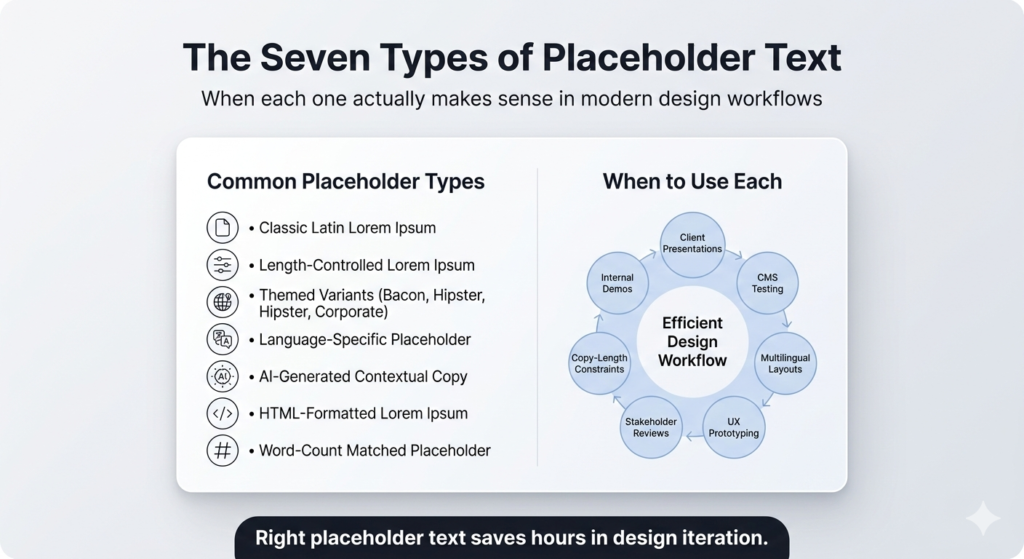
The explosion of Lorem Ipsum generators over the past two decades has produced dozens of variants, from the practical to the genuinely entertaining. Knowing which to reach for and when makes your workflow meaningfully more efficient.
Classic Latin Lorem Ipsum — This is the standard passage and its extended variants. It’s what you should use for any design work intended to be shown to people who haven’t seen your design before, to stakeholders, to clients, or anywhere the placeholder text might be screenshotted or shared. It reads as obviously non-content to almost everyone, which keeps attention on the design.
Length-controlled Lorem Ipsum — The best modern generators let you specify exactly how many words, sentences, or paragraphs you need. A one-click generator that produces a fixed block is fine for casual use, but if you’re building a content-heavy layout with variable text lengths across card components, a well-designed generator where you can request exactly six words for a card title and exactly two sentences for a card description saves significant time.
Themed Lorem Ipsum variants — Bacon Ipsum, Hipster Ipsum, Corporate Ipsum, Pirate Ipsum, Cupcake Ipsum, and dozens more. These exist for good reasons beyond novelty. When you’re presenting to a client with a sense of humor, a themed Lorem Ipsum makes the mockup review more pleasant. It signals that the text isn’t real in a way that even non-designers immediately grasp. When you’re demoing something internally or testing a layout with a team who needs to stay engaged, themed variants keep energy up. Where they fail: anywhere the placeholder might confuse a client into thinking it reflects actual brand voice, or anywhere the text will be screenshotted and the screenshot will circulate.
Language-specific placeholders — If you’re designing for a multilingual product, testing your layout with Arabic or Japanese or Hebrew placeholder text before the actual translations arrive is significantly more valuable than testing with Latin. Right-to-left scripts alone will break layouts that worked perfectly fine with Latin placeholder text. German compound words will overflow containers that looked fine with English. Designing with the character density and directionality of the actual target language catches problems early.
AI-generated contextual placeholder — A newer category: placeholder text that sounds topically relevant without being final copy. “Discover the handcrafted collection of seasonal items sourced from local artisans” is not Lorem Ipsum, but it’s not the client’s actual tagline either. This kind of placeholder is useful when testing how real copy length and tone will feel in a design, and when you need stakeholders to respond to layout decisions without distracting them with actual brand messaging debates. Use it with clearly visible “PLACEHOLDER COPY” labels so nobody confuses it for approved content.
HTML-formatted Lorem Ipsum — Some generators produce Lorem Ipsum pre-wrapped in HTML tags — paragraph tags, heading tags, bold and italic markup. This is specifically useful for CMS development and template testing, where you need to see how your CSS handles various markup patterns. Drop structured Lorem Ipsum into a WordPress template and you’ll immediately see whether your heading hierarchy renders correctly and whether your paragraph spacing handles multiple consecutive text blocks well.
Word-count matched placeholders — Some projects have known constraints: a meta description must be under 160 characters, a tweet must fit within 280, a push notification has strict limits. Generating placeholder text that specifically matches those constraints lets you test layout at the correct scale.
When Lorem Ipsum Is the Wrong Choice (And What to Use Instead)
There are specific situations where Lorem Ipsum will actively mislead you, and recognizing them saves real rework later.
Content-heavy editorial layouts are the most common trap. If you’re designing a news site, a blog platform, or any layout where the text length and density is a fundamental design constraint — not just a variable — testing with Lorem Ipsum gives you false confidence. An article summary that fits perfectly at 120 words of Lorem Ipsum may overflow badly when the actual article summaries average 85 words. The right move here is to use real content samples from the actual source, or to use synthetic placeholder text that matches the real content’s average length constraints.
E-commerce product descriptions present a similar challenge. Product names vary from two words to twenty. Descriptions range from a single sentence to multiple paragraphs depending on the product and category. Lorem Ipsum blocks of uniform length won’t show you what your layout does with real variance. Pull actual product names and descriptions from the client’s existing catalog — even rough draft versions — before finalizing a product card design.
Pricing tables and data-heavy components need real numbers or at minimum realistic placeholder numbers, not text. “Lorem ipsum” in a pricing column is visually useless. You need to see whether a five-digit price breaks your layout differently than a two-digit price.
Finally, accessibility and internationalization testing require real language patterns. Screen readers, keyboard navigation, and automatic translation systems interact with text content in ways that Latin gibberish won’t surface. For accessibility testing, use actual draft copy or at minimum grammatically coherent English (or the target language) rather than Lorem Ipsum.
Building a Practical Placeholder Text Workflow That Doesn’t Slow You Down
Most designers don’t have a formal placeholder text workflow — they paste whatever Lorem Ipsum is on their clipboard, adjust length manually, and repeat. With a bit of structure, the same task takes half the time and produces more useful results.
The first upgrade is having a reliable generator bookmarked that produces variable output on demand. The difference between a generator that outputs a fixed Lorem Ipsum passage and one that generates exactly N words or N paragraphs with a single click is significant when you’re working across twenty card components that all need different text lengths.
The second upgrade is maintaining a small library of real content samples for the projects you work on most. Two or three real headlines, a couple of real body paragraphs, a set of real button labels — these don’t need to be final approved copy. They just need to reflect the actual content’s length and character density. Keep them in a scratch file and paste from there rather than Lorem Ipsum when you’re testing layout behavior around variable content.
The third upgrade is using Lorem Ipsum strategically in client presentations. Don’t use themed variants in anything that will be shared with stakeholders who don’t know the design context. Use standard Lorem Ipsum and add a visible label in your presentation notes that these are placeholder text blocks. This prevents the inevitable “wait, is that your copy?” question that wastes 10 minutes of every stakeholder review.
The Design Inbox Problem — Keeping Your Research Clean
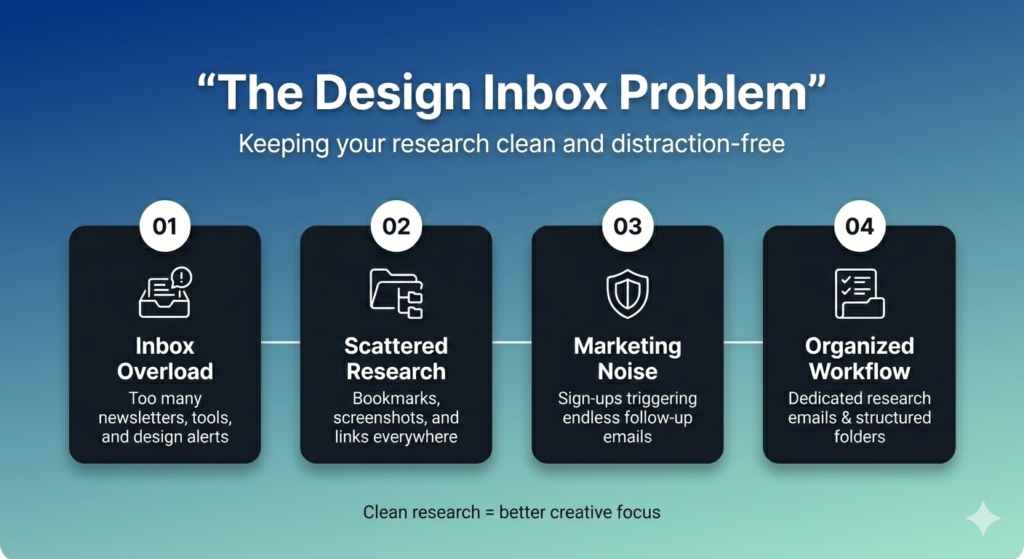
Here’s something that comes up regularly for designers and developers in the placeholder text and frontend workflow space that isn’t specifically about Lorem Ipsum but affects the day-to-day experience of keeping your design resources organized.
When you’re actively searching for new generators, testing design platforms, trying out Figma plugins, exploring new CSS frameworks, or browsing any of the hundreds of developer and design resources that require account creation — almost every one of them wants your email address at signup. Most will immediately add you to a newsletter. Within a week of serious tool exploration, your inbox has new entries from six different platforms, three of them sending daily emails about features you haven’t tried yet.
If you’re in a phase of heavy research or testing — exploring multiple Lorem Ipsum generators, trying out different design system platforms, pulling inspiration from new sources — it’s genuinely worth using a dedicated inbox address for that research phase. Your primary inbox stays clean, and you’re not trading off inbox clarity for the ability to access free resources behind an email gate. Once you decide which platforms are actually worth committing to, you create proper accounts with your real contact information and join whichever newsletters are actually worth reading.
It’s a small habit that has a noticeable effect on how focused and manageable your daily inbox feels when you’re in an active learning or exploration phase as a designer.
The Future of Placeholder Text: Where It’s Heading
The role of Lorem Ipsum is shifting as AI-generated content becomes a standard part of design and development workflows.
The traditional problem Lorem Ipsum solves — how do you fill space with non-distracting text so stakeholders can evaluate visual design rather than editorial content — is now being approached differently by teams using AI writing assistants. Instead of inserting Lorem Ipsum and replacing it with real copy later, some teams now generate contextually appropriate draft copy during the wireframe phase and refine it through the design process. The placeholder and the copy become the same thing, evolving together.
This approach has real advantages in reducing the gap between design and content production. It has real risks in creating over-attachment to AI-generated draft copy that should still go through proper editorial review.
The answer, predictably, is that both approaches have their place. For early architecture testing — grid systems, spacing, typography hierarchy, visual weight — pure Lorem Ipsum without any semantic meaning remains the right choice. For user testing, stakeholder presentations, and content-adjacent decisions, contextually relevant placeholder text (AI-generated or otherwise) is more useful.
What this means in practice is that designers and developers in 2025 need a richer placeholder text toolkit than they needed in 2010. Classic Lorem Ipsum, themed variants, language-specific placeholders, AI-generated contextual copy, and structured HTML-formatted text all serve different purposes. Having fast access to the right type for the situation in the moment is what separates a fluid design workflow from a slightly annoying one.
Why a Generator That Works in One Click Actually Matters
This probably sounds like it shouldn’t need arguing. Of course faster is better.
But the friction cost of placeholder text generation is consistently underestimated. When you’re deep in a layout and you need to fill twelve card components with text of varying lengths, the difference between a generator that takes three clicks and adjustments versus one that produces the right output in one click isn’t just about those specific seconds. It’s about the interruption to your design thinking.
Cognitive flow in design work — the state where you’re making fast, intuitive decisions about visual relationships without stopping to deliberate — is genuinely valuable and genuinely fragile. Any task that requires you to leave your design application, navigate to a site, adjust settings, copy output, and return breaks that flow. A generator with a clean interface, immediate output, and easy length control minimizes that interruption. One that requires you to figure out why it’s producing the same block every time or navigate three pages to change the output format adds friction that compounds across every use.
The Lorem Ipsum generator at lorem-ipsumm.com is built around this principle — one click, fresh text, immediate copy. For designers and developers who generate placeholder text multiple times per day, that simplicity has real cumulative value.
The Closing Argument for Taking Placeholder Text Seriously
There’s a kind of design maturity that comes from paying careful attention to the things that feel like formalities.
Lorem Ipsum is a formality — it’s the text you use when you don’t have the real text yet. But how you handle that formality affects the quality of every presentation, every design review, every handoff, and every layout stress test you conduct. Using the right type of placeholder text for the right situation keeps your design conversations focused on design. Using real content constraints rather than uniformly sized Lorem Ipsum blocks surfaces layout problems before they become development problems. Maintaining a clean, focused working environment — including your inbox — while you’re deep in a design research phase keeps your cognitive resources on the work.
The 15th-century typesetter who scrambled Cicero’s philosophical text to fill a type specimen book was solving a real problem: how do you show what something will look like before you know what it will say? That problem hasn’t gone away. It shows up on every new design project, every prototype, every template and component library. The tools for solving it have gotten much better. Using them well is worth the attention.
Lorem ipsum dolor sit amet. Five hundred years in, and the placeholder still has something to teach.